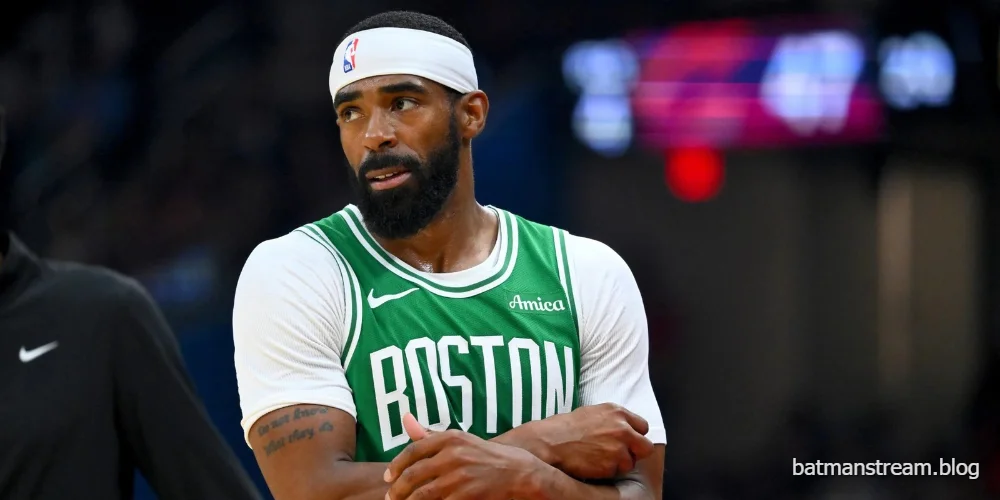
Mike Conley experienced a different side of professional basketball on Wednesday, taking responsibility for the Boston Celtics’ player rotations during their 114-93 preseason victory over the Charlotte Hornets. Rather than joining his teammates on the court, the veteran guard spent the game helping determine when players entered and left the action, gaining a closer look at the decisions facing head coach Joe Mazzulla.
The unusual assignment offered Conley an opportunity to contribute beyond his playing duties as he prepares for his 20th NBA season. It also reflected Boston’s effort to make use of his experience and leadership as the team prepares for the 2026-27 campaign.
Although Conley has spent nearly two decades competing at the highest level, managing substitutions in a live game presented a new challenge. The experience gave him a practical introduction to the adjustments coaches must make when a game does not follow the original plan.
Joe Mazzulla Gives Conley Responsibility for Boston’s Rotations
Mazzulla approached Conley before the game and asked whether he would be willing to oversee the Celtics’ substitutions. Conley accepted, despite having never handled that responsibility during an NBA game.
Armed with a rotation sheet prepared with help from the coaching staff, he watched closely from the bench and directed teammates when it was time to enter the contest. The Celtics won comfortably, but the assignment was about more than the final score.
Conley had to consider how the game was unfolding, whether players were tiring and when a lineup was performing well enough to remain together. Those decisions can quickly become complicated when foul trouble or an unexpected run changes the coach’s original plan.
The exercise also gave Conley a chance to understand Mazzulla’s approach from a different perspective. Instead of concentrating exclusively on his own responsibilities as a player, he had to think about the needs of the entire lineup.
Derrick White’s Early Foul Trouble Tests Conley
One of Conley’s first significant decisions came early in the opening quarter when Derrick White picked up his second personal foul just over two minutes into the game.
The situation threatened to disrupt the planned substitution pattern. Conley considered how to protect White from further foul trouble without making an unnecessary change to the rotation.
He ultimately decided to leave White on the floor after speaking with him about avoiding another foul. White stayed out of trouble, allowing Conley to bring Payton Pritchard into the game shortly afterward without disrupting Boston’s lineup.
The moment illustrated how quickly a seemingly straightforward rotation plan can require intervention. Coaches must balance the risk of leaving a player on the court with the potential consequences of changing the lineup too early.
Other situations also required Conley to adjust his thinking. A player might need a rest, while another could be scoring repeatedly and building momentum. Deciding when to make a change involves reading the game as it develops rather than following a predetermined schedule.
Conley sought guidance from Mazzulla when those decisions became difficult, using the opportunity to learn how the head coach evaluated different combinations.
Conley Gains a New Perspective on Coaching
Conley’s experience reinforced his appreciation for the complexity of coaching. Even with a prepared plan and support from Boston’s staff, he discovered that managing a game requires constant attention to details that may not be obvious from the court.
The Celtics guard also spent time discussing basketball concepts with Mazzulla during the second half. Their conversations covered how the team was functioning offensively and defensively, along with the reasoning behind certain tactical decisions.
With Boston holding a comfortable lead in the fourth quarter, Mazzulla pointed out how effectively the players were working together despite limited use of structured offensive sets during the game. The discussion gave Conley a closer look at the importance of communication, spacing and the ability to make decisions collectively.
For a player with extensive NBA experience, the opportunity was valuable because it connected years of on-court knowledge with the responsibilities involved in directing a team.
Conley has played for several organizations during his career, building a reputation as a steady veteran presence. His new assignment in Boston allowed him to use that experience in a different way while strengthening his relationship with Mazzulla.
Boston Wants Conley’s Leadership Beyond the Court
The Celtics signed Conley during the 2026 offseason, bringing him to Boston after his time with the Minnesota Timberwolves. The veteran guard is expected to contribute as a player, but his influence within the locker room is also an important part of his role.
At this stage of his career, Conley can help younger teammates understand game situations, prepare for opponents and maintain composure during difficult stretches. His experience also gives him a useful perspective when communicating with players who are still developing their roles.
Mazzulla has encouraged that kind of involvement throughout the preseason. During Boston’s preseason opener, assistant coaches Tony Dobbins and DJ MacLeay shared head-coaching responsibilities, giving both an opportunity to experience the role after interviewing for head coaching positions during the offseason.
Conley’s assignment followed a similar philosophy: allowing people around the team to take on responsibilities that expand their understanding of the game.
Mazzulla explained that a veteran who has worked with different coaches and successful teams can offer valuable insight. He also emphasized the benefit of helping players and coaches understand each other’s thinking, particularly when new teammates are learning the system.
That shared understanding could become important once the regular season begins and decisions must be made quickly under greater competitive pressure.
Could Mike Conley Become an NBA Coach?
Conley has not committed to becoming a coach after his playing career, but he has expressed a desire to remain involved in basketball in some capacity.
He has acknowledged that coaching requires substantial time and effort, and he is still considering what his next professional chapter might look like. Management and coaching are both possibilities, although he has not announced a specific plan.
His performance in Boston’s preseason exercise nevertheless offered a glimpse of the qualities that could serve him well in a future leadership role. Conley showed a willingness to accept an unfamiliar assignment, seek advice and adjust when the game presented unexpected problems.
Celtics teammate Sam Hauser even suggested that Conley could make a strong coach, reflecting the respect he has earned from those around him.
For now, his priority remains contributing to Boston in whatever capacity the team needs. The rotation assignment was a learning experience rather than a formal change in his job title, but it demonstrated how the Celtics intend to benefit from his basketball knowledge.
What Conley’s New Role Means for the Celtics
Boston’s decision to involve Conley in game-management responsibilities highlights the value the organization places on communication and shared understanding. His experience can help teammates interpret situations more effectively, while his conversations with Mazzulla may give him a deeper appreciation of the coaching staff’s priorities.
The preseason victory over Charlotte provided a useful setting for the experiment. With the regular season approaching, Boston had an opportunity to explore different ways of building chemistry without placing Conley in a conventional playing role for the night.
His long-term impact will depend on how his responsibilities develop and how much he contributes on the court. However, the Celtics have made clear that his value is not limited to minutes played or statistics recorded.
For Conley, the experience opened another door in a career that has already spanned nearly 20 NBA seasons. Whether he eventually pursues coaching or another basketball-related role, his willingness to learn from the sidelines suggests that he intends to remain connected to the game long after his playing days end.
Comments (0)
No comments yet. Be the first to share your thoughts!
Leave a Reply
Note: Links and URLs are strictly prohibited. All comments undergo moderation before being published.